
The December Capital Vote
Update: 10/8/26
On Tuesday, December 8, voters in the Rome City School District will decide two questions about a $31.1 million building project. The plan would tear down the former Staley Elementary School, add a gym, cafeteria and auditorium to the Clough building, and replace the closed grandstand at RFA Stadium. The district says the project will not raise taxes. Critics question whether that holds up, and several important facts are still in dispute. Below is what you are voting on, the arguments on each side, how the project would be paid for, and the questions that have not been answered yet.
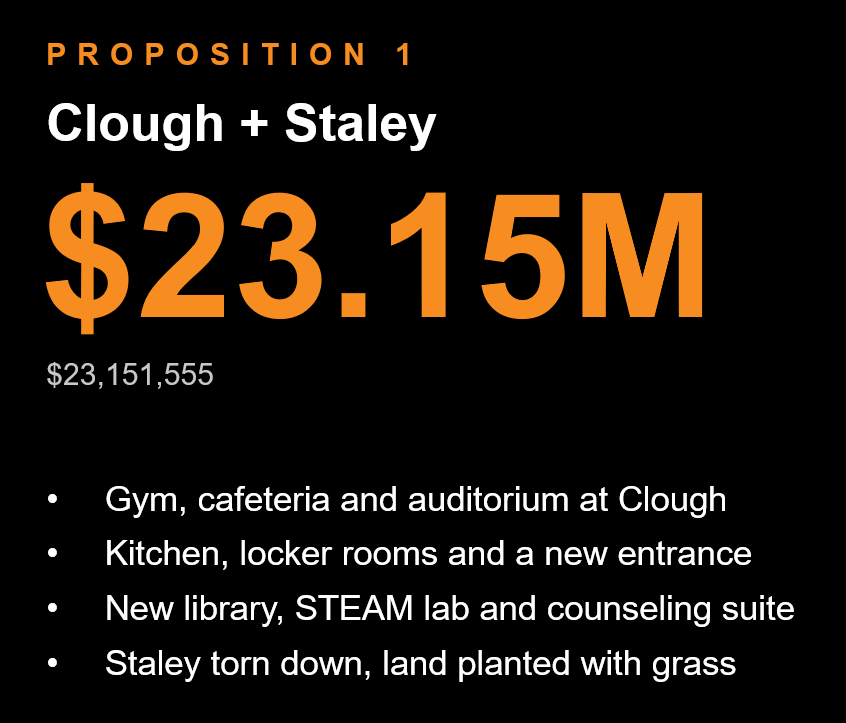
Proposition 1: Clough and Staley, $23,151,555. This question pays for an addition of about 16,000 square feet at the Clough building on Bell Road. The addition would include one large room that works as a gym, cafeteria and auditorium, plus a kitchen, locker rooms, offices, storage, a new lobby and entrance, and a loading dock. About 6,000 square feet inside the existing building would be renovated, including a new library, a STEAM lab and a counseling suite. The district describes part of the design as a "connecting hub" where future additions could attach. Proposition 1 also pays to demolish the former George R. Staley Elementary School, remove the paved areas around it, and plant the land with grass.
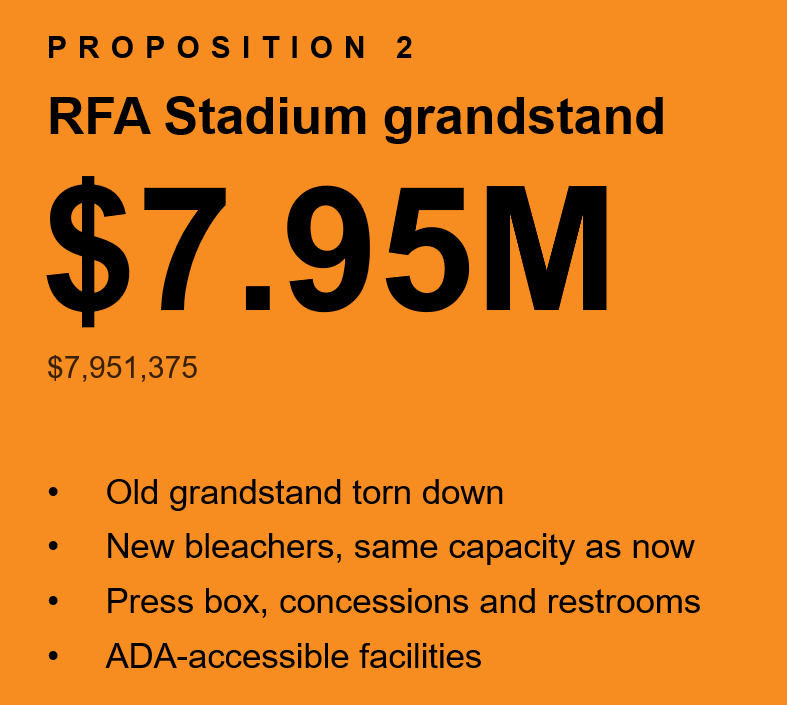
Proposition 2: RFA Stadium grandstand, $7,951,375. This question tears down the closed grandstand and concession stand at RFA Stadium and replaces them with new bleachers holding the same number of people as the old ones, a press box, a concession and restroom building, and ADA-accessible facilities.
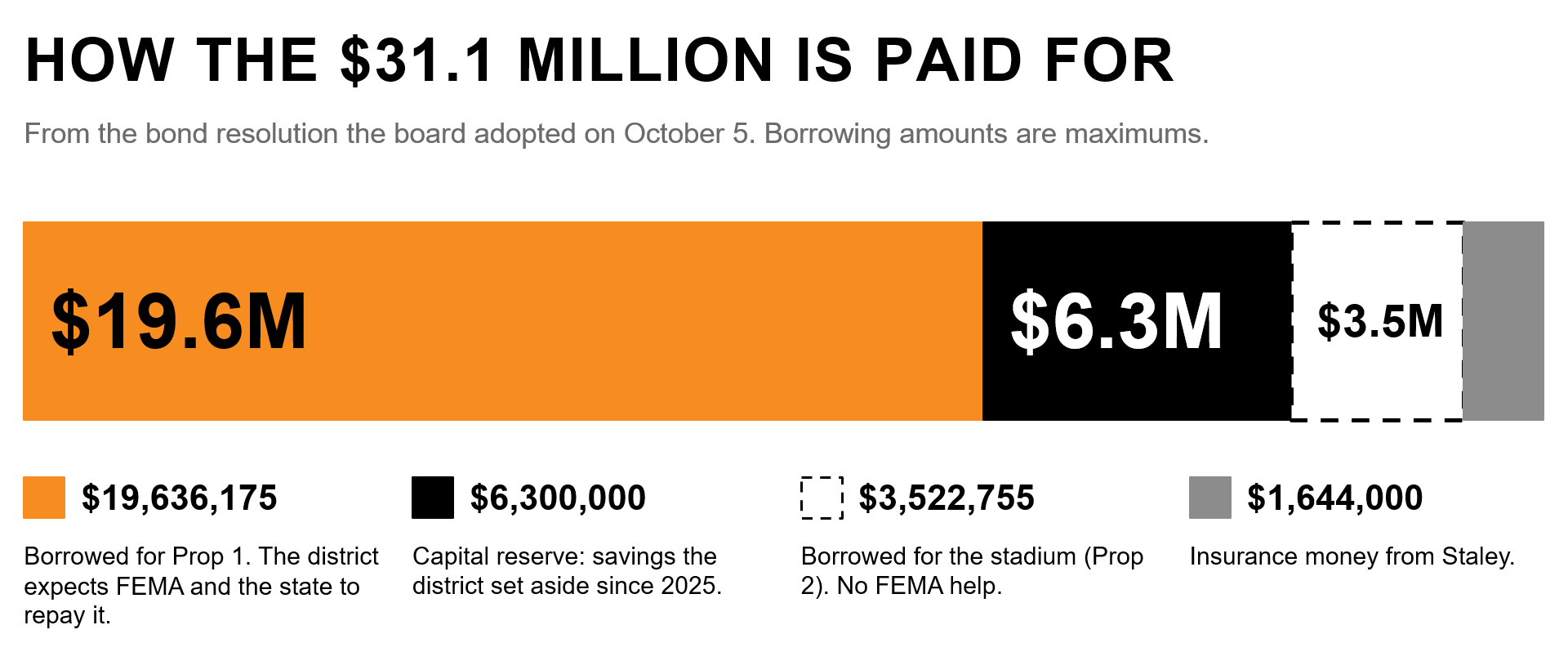
FEMA money is a reimbursement, not a check. The district has to borrow the money, spend it, document the work, and then get paid back. That is why Proposition 1 authorizes borrowing equal to the full FEMA and state amount.
Where the reserve money came from. The capital reserve had about $3.3 million in it. On September 21, the board moved another $3 million in leftover money from last school year into it, which the business office said would bring it to about $6.3 million.
What the district says covers the rest. The district says state building aid, "existing debt service resources" and other "financing strategies" will keep the project from raising taxes. It has not publicly broken down how those pieces work, including how the $3.5 million borrowed for the stadium would be repaid. In August, the business office estimated the district would need to borrow about $2 million beyond its reserves. The final resolution authorizes up to $3,522,755 for the stadium alone. These are maximums, and the district may borrow less.
The Case For
These are the arguments the district, its consultants and supporters have made at board meetings and in district materials.
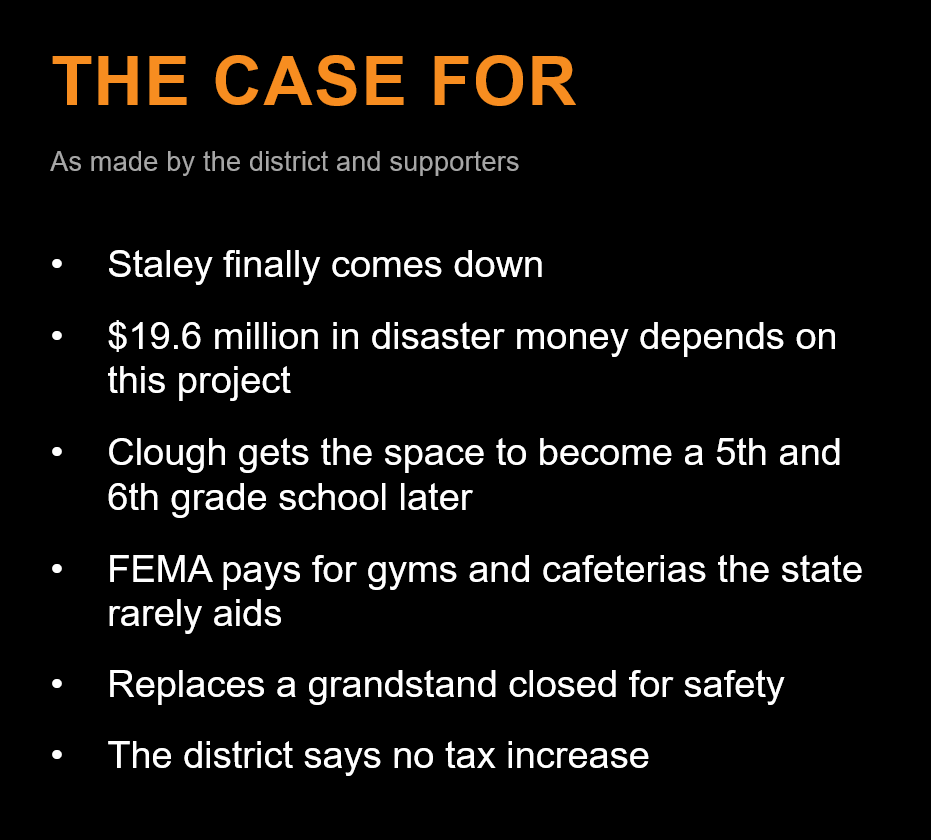
Staley has to come down, and the money to help is on the table. Staley has been empty since the 2021 flood, sits in a flood zone and cannot be used as a school again. The district says demolition is a condition of receiving its FEMA reimbursement. The building has been broken into and vandalized, and Rome's mayor has publicly called for it to be torn down. Supporters say this vote is the way to finally make that happen.
About $19.6 million in disaster recovery money depends on it. The district has been approved for $19,636,175 in FEMA and state emergency management funding tied to the loss of Staley. That money comes with a deadline. The superintendent told the board that if the project does not move forward, all of it is at a standstill.
The schools are still crowded. According to the district, Staley's closing sent about 582 students into other buildings. The long-term plan is to make Clough a building for fifth and sixth grade, which would free up room in the elementary schools. Supporters say this project is the first step, adding the large shared spaces a school of that size needs.
The disaster money covers what the state usually won't. New York gives little or no building aid for gyms, cafeterias and auditoriums. District consultants said that is exactly why the plan aims the FEMA money at those spaces.
The grandstand is closed and unsafe. The structure has been deteriorating for years, was closed to the public for safety reasons before this year's graduation, and the district's architect recommends replacing it rather than repairing it again. The stadium hosts graduation, athletics, track and field, and community events.
The district says it won't raise taxes. The district says the project is structured to be cost neutral, using FEMA money, insurance money, a capital reserve the board began building in 2025, state building aid and other financing. The board voted for the plan with no one voting no.
The Case Against
These are concerns raised by board members, residents and documents in the public record.
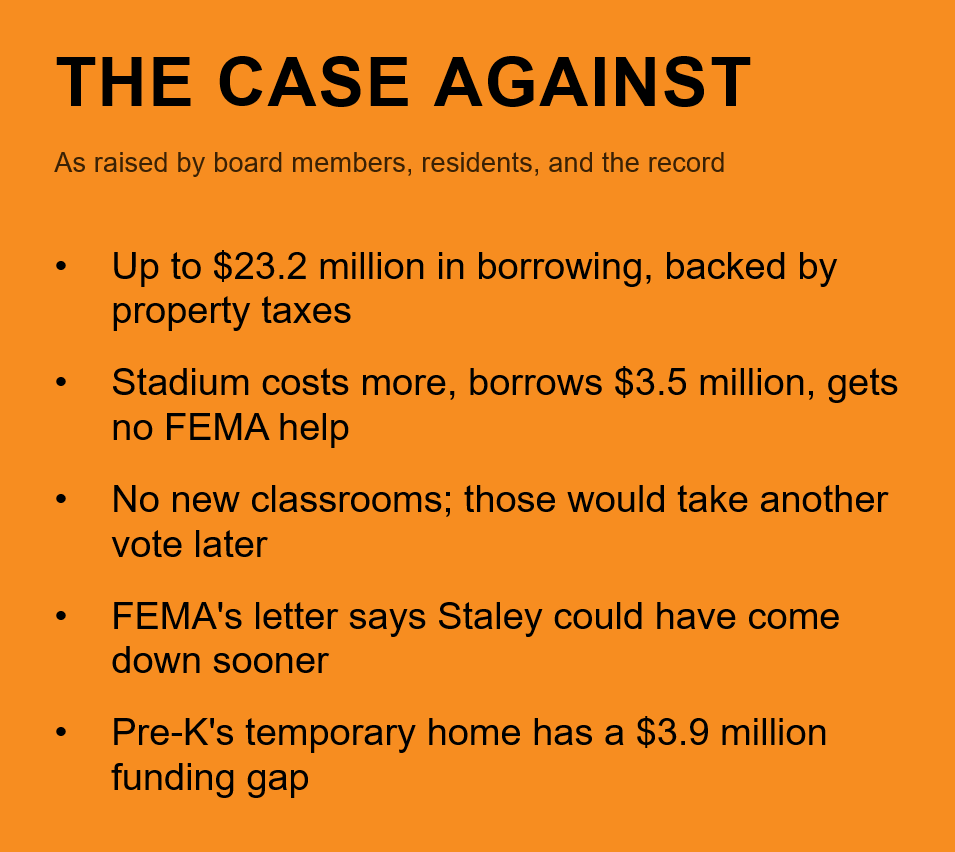
The tax promise rests on things that haven't happened yet. The ballot questions authorize the district to borrow up to about $23.2 million, and like all school bonds, that debt is legally backed by property taxes. The district expects FEMA reimbursements and other money to cover the payments. If any of that falls short, taxpayers are on the hook. The district's FAQ does not mention the borrowing at all.
The stadium piece costs more and gets no disaster money. In August, board member Rocky Capponi questioned a stadium figure of about $6.5 million. The final proposition is $7,951,375, and it adds a press box, restrooms and ADA facilities. None of it is covered by FEMA. The plan uses about $4.4 million from the reserve and borrows up to $3.5 million for it. And because of how the questions are linked, voters cannot approve the stadium without also approving the Clough and Staley work.
It doesn't add classrooms. The project's main goal is easing crowding, but it adds no new classrooms. The board has said classrooms could come in a future project, which would mean another vote and more spending later. Capponi argued that Rome can't count on the Chobani plant to drive enrollment, and that families moving to the area for jobs will compare Rome's schools to those in neighboring districts.
Staley could have come down sooner. A September letter from FEMA to Mayor Jeffery Lanigan says the district was already approved to use its project funding to demolish Staley, and that its reports showed the project had not yet begun five years after the flood. Resident Dennis Perfetti told the board the district has had the money and should have acted, warning that a firefighter or police officer could be hurt inside the empty building.
The plan for pre-K is uncertain. Clough currently houses the district's pre-K program and offices, which have to move during construction. The plan has been a five-year lease of the former Roman Catholic Academy on Cypress Street, which runs about $7.1 million. The state approved about $2.2 million in aid toward it, leaving roughly $3.9 million unfunded. Capponi told the board in August he believed the deal was close to falling apart.
Open Questions
When does the FEMA money run out? District officials have told the board the deadline is October 2029. FEMA's September 14 letter to the mayor says the project's deadline is October 8, 2027, with no guarantee of an extension. The superintendent called that letter unsigned and has not addressed the 2027 date publicly. If 2027 is correct, design, state approval, bidding and construction would all have to fit into the months after the vote.
Can FEMA money pay to tear down Staley? In August, the district said FEMA had determined the money could not be used for demolition. FEMA's September letter says the district is already approved to use project funds for demolition and is required to do it. On October 5, the superintendent said state emergency officials told the district from the start it could not use the money for demolition until the Clough project was approved, and that the state agency endorsed her public statement.
Does the project match what FEMA approved? FEMA's letter says the version it approved in January 2026 included new classrooms, and that the district must complete all approved work. Proposition 1 has no new classrooms. It is not clear whether the district has asked FEMA to approve the change.
How is the stadium borrowing repaid without a tax increase? The district has not explained which money pays off the $3.5 million borrowed for Proposition 2.
Why don't the borrowing totals match? The resolution caps the district's total borrowing at $22,091,430. The two ballot questions authorize $19,636,175 and $3,522,755, which add up to $23,158,930. That is a difference of $1,067,500. It may be a typo. It has not been explained. (See pages 17, 18 and 21 of the October 5 agenda.)
What happens if Proposition 1 fails? The district's FAQ does not say.
Where do pre-K and the district offices go during construction? The district has said pre-K stays at Clough this year and that it has options for 2027-28 using its own buildings if the lease falls through. It has not said what those options are, or how the $3.9 million lease gap would be covered.
Why was Staley written off for $2.5 million? On October 5, a board member said last year's audit showed Staley written off for $2.5 million. The superintendent said she would get an answer from the business office. It has not been shared publicly yet.