Rome City School District
Board of Education
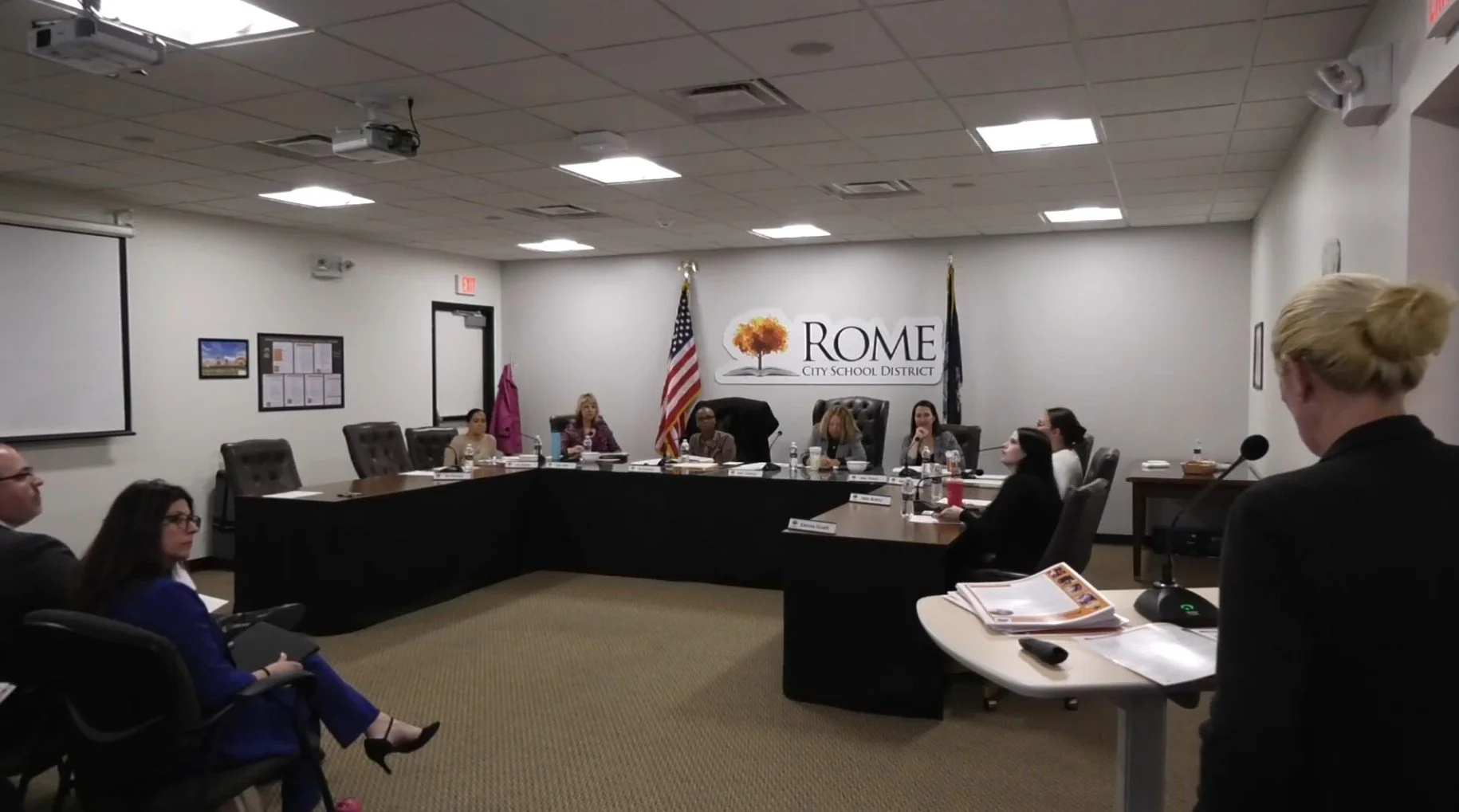
The Rome City School District Board of Education sets the overall direction and policies for the district's schools. It adopts the annual budget that goes before district voters, hires and oversees the superintendent who manages day-to-day operations, and approves major decisions ranging from curriculum to facilities. The board is accountable to local voters and taxpayers who trust the Board to oversee how the district educates its students and spends public money.
The Stories We Are Following:
Short on time? These are the three Board of Education threads that you need to know about in Rome Right Now.

The Audit Is Due This Month, And A $2.5 Million Staley Question Is Still Waiting For An Answer.
At the October 5 meeting, a board member said last year's audit showed the Staley building written off for $2.5 million, taken off the district's books as property held for sale, and asked why. The superintendent said she could not answer because Assistant Superintendent for Business Dr. Georgia Gonzalez was not there, and promised an answer by email and at a future meeting. This year's annual audit is still underway. The district said in August that results were expected in October, and the audit committee has not set a meeting date.
The audit matters for December. In September, before the audit was finished, the board moved $3 million in leftover money into its capital reserve, bringing it to about $6.3 million, which the business office said would go toward the building project. Dr. Gonzalez has said her goal is to put any additional leftover money into the reserve, which could reduce how much the district borrows. The board has also adopted the calendar for next year's budget. In June, the business office warned the district faces a deficit in 2027-28 unless it keeps raising the tax levy by about 2.5% a year.
Watch for the audit results and an audit committee date. Watch for the business office's answer on the Staley write-off, which was promised publicly. And watch for the dates in the 2027-28 budget calendar, which still have not been shared.

The District And FEMA Give Different Deadlines For The Money Behind The Vote.
About $19.6 million in FEMA and state emergency money tied to Staley is the reason this vote is happening now. District officials have told the board the money has to be spent by October 2029. A September 14 letter from FEMA to Mayor Jeffery Lanigan, now circulating online, says the deadline is October 8, 2027, with no guarantee of an extension. The letter also says the district was already approved to use the money to tear down Staley. In August, the district said FEMA funds could not be used for demolition.
The deadline matters because if 2027 is right, design, state review, bidding and construction would all have to fit into the months after a December vote. On October 5, the superintendent called the FEMA letter unsigned. She said state emergency officials told the district from the start it could not spend the money on demolition until the Clough plan was approved, and that the agency has endorsed her account. She repeated the 2029 date but did not address 2027. Meanwhile, Staley sits empty, the mayor has called for it to come down, and a board member and residents have described repeated break-ins.
Watch whether the district or FEMA settles the deadline before December 8. Also watch whether the district explains how a plan with no new classrooms fits the version FEMA approved, which the letter says included them. Both questions are fair game at the October 14 information session.

Rome Votes December 8 On Two Building Questions Worth $31.1 Million.
On October 5, the board made the December 8 vote official. There are two questions. Proposition 1, at $23,151,555, adds a gym, cafeteria and auditorium to the Clough building, plus a new library, STEAM lab and counseling suite, and tears down the former Staley school. Proposition 2, at $7,951,375, replaces the closed RFA Stadium grandstand, but it only counts if Proposition 1 passes. Neither question adds classrooms.
The district says the project will not raise taxes. The money comes from four places: up to $19.6 million borrowed that the district expects FEMA and the state to repay, $6.3 million in district savings, up to $3.5 million borrowed for the stadium with no FEMA help, and $1.6 million in insurance money from Staley. Like all school bonds, the borrowing is backed by property taxes, and the district has not explained how the stadium loan gets repaid without a tax increase. The resolution also caps total borrowing at $1,067,500 less than the two ballot questions add up to.
Watch the information sessions on October 14 and November 17, both at 6 p.m., for answers on the stadium loan and the borrowing total. Voter registration is November 23 and 24, and absentee applications are due December 1 if mailed. Our VOTER ALERT below has the full breakdown, the case for and against, and the open questions.
VOTER ALERT (UPDATE 10/8/26) - December Vote Finalized

October 5, 2026 - Now It's Official
VOTER ALERT (UPDATE 9/24/26) - Two Questions on December 8th
September 21, 2026 - The Other Capital Project
September 8, 2026 - New Doors, and Hard Numbers

August 17, 2026 - Families Speak Up
VOTER ALERT - Capital Spending - December 2026

August 3, 2026 - Three Options, One Deadline

July 16, 2026 - Who Runs High School?

*SPECIAL* July 16, 2026 - Reorganizational Meeting

June 15, 2026 - Back to the Ballot Box
June 2, 2026 - A Packed House Before the Re-Vote

May 20, 2026 - The Budget Fails, the Buses Pass
May 11, 2026 - The Last Word Before the Vote

April 21, 2026 - Parents Press for Answers

April 1, 2026 - The Budget Heads to the Ballot

March 16, 2026 - Two Questions for May

March 2, 2026 - Doing the Math

February 9, 2026 - The Buses Wouldn't Start
January 26, 2026 - A Ride for the Walkers