
The December Capital Vote
The Short Version
Rome's elementary schools are crowded. The district wants to renovate and expand the Clough building so it can hold older elementary students and free up space everywhere else. To pay for a large part of it, the district has about $19 million in FEMA money connected to the Staley school, which was lost to flooding in 2021. But that money has to be spent by October 2029, and spending it requires public approval first.
So there will be a vote, most likely in mid-December 2026. The board had three versions to choose from, and selected the middle option on on August 17, 2026.

SELECTED
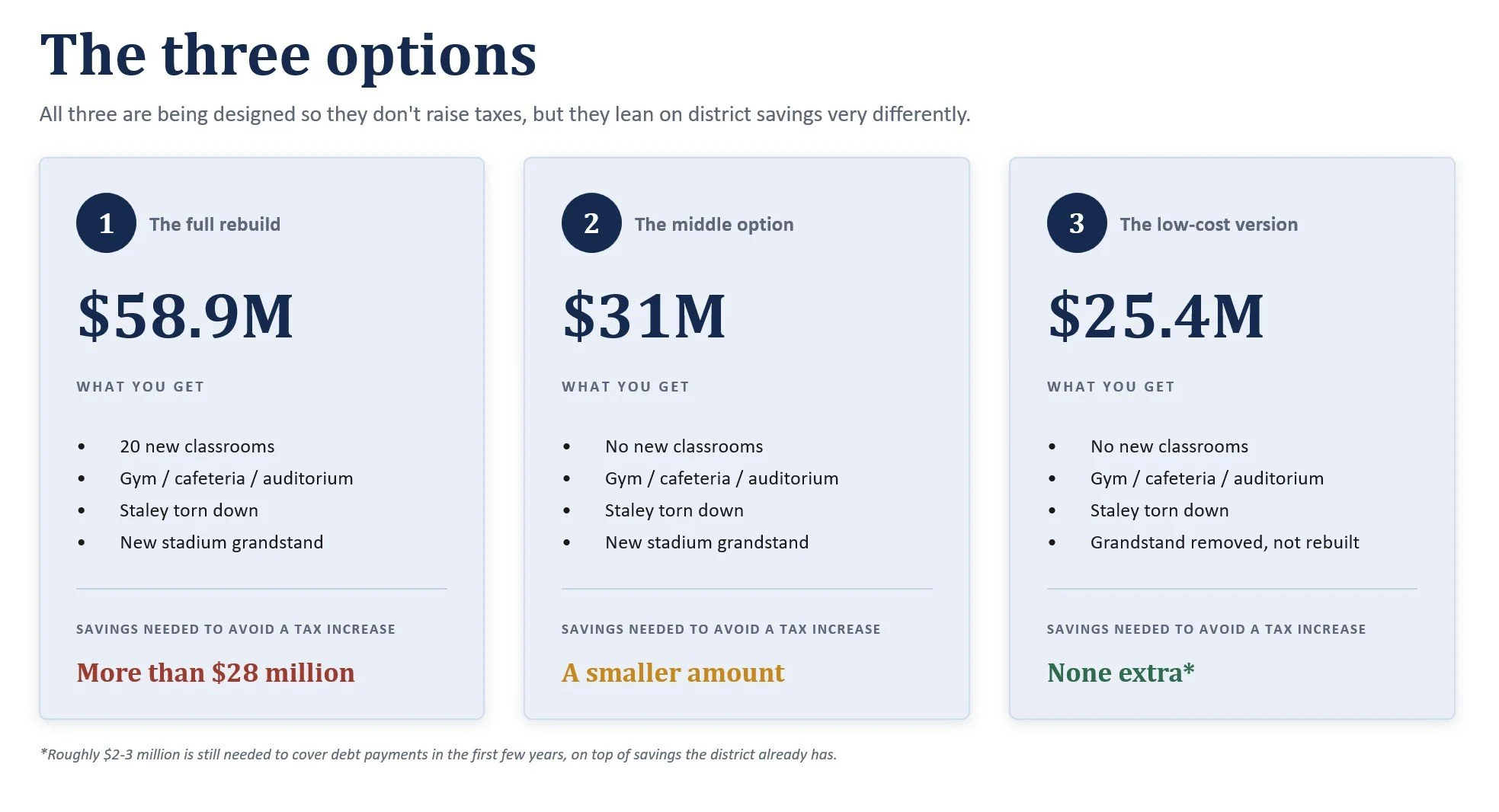
The Middle option
Cost: Appx $31,000,000
Clough still gets the gym/cafeteria/auditorium and interior renovations to make it ready for sixth grade. Staley comes down. The stadium grandstand is demolished and rebuilt, along with a new concession and restroom building. Drops the 20 classroom addition.
The Case For
It solves the most urgent piece (getting sixth grade out of the elementary schools) without triggering the district-wide aid recalculation. The other six schools keep their allowances intact.
It rebuilds the grandstand. Because that work will never qualify for state building aid, it comes out of local pockets whether it happens now or in ten years. Bundling it into a project that's already going to voters may be the cheapest way to get it done.
It's a phased approach. The fifth-grade move can happen in a future project, when the district has a clearer picture of enrollment and better timing on its state aid.
It needs far less reserve money than Option 1.
The Case Against
It doesn't solve the whole problem. Fifth grade stays put, and Rome will be back for a second project later.
If enrollment does grow, the district is in the same squeeze again, and the classrooms it skipped will cost more to build then.
The grandstand rebuild is pure local cost with no state help, which some voters will see as the wrong priority when classrooms are the stated problem.
It still requires some additional reserve money to stay tax-neutral.
NOT SELECTED
The Full Rebuild
Cost: Appx $58,900,000
Adds 20 classrooms (including special education and resource rooms), the gym/cafeteria/auditorium, a library media space, a large-group STEM classroom, and dedicated music and art rooms. Both fifth and sixth grade would eventually move to Clough. Staley comes down and the stadium grandstand is rebuilt.
The Case For
It's the only version that actually adds classroom space. The others reshuffle what Rome already has.
It moves both fifth and sixth grade out of the elementary schools, which is the fullest fix for overcrowding.
Building costs tend to go up over time. Adding space later may cost significantly more than adding space now.
Micron and Chobani are both building in the region. If those jobs bring families, the district could be short on space again.
It gives music and art dedicated rooms for the first time, and restores a stadium the community can use for graduation and events.
The Case Against
This is the big one. To get state aid for the new classrooms, the district would have to choose to let the state recalculate building aid across the whole district. That recalculation would add about $8.8 million in spending allowance at Clough while cutting roughly $15.5 million from the six other elementary schools.
*But that trade is a choice, not a requirement. Rome can keep its existing allowances and decline state aid on the new classrooms, paying for them locally instead. The district's adviser described another district that did exactly that after learning the recalculation would have cut its allowances roughly in half.*
The district needs more than $28 million in additional reserve money to stay tax-neutral. If that money isn't there, the difference lands on taxpayers.
The district's own enrollment study did not find growth large enough to justify Rome's current aid levels, which still reflect the era when Griffith Air Force Base was open. So the extra classrooms are a bet on growth that hasn't been documented yet.
It's the largest borrowing and the longest construction timeline of the three.
NOT SELECTED
The Low-Cost Version
Cost: Appx $25,400,000
The same as Option 2, except the stadium grandstand is torn down and not replaced. The space is cleared and left ready for bleachers to be added later.
The Case For
It's the cheapest option and, according to the district's advisers, requires no additional capital reserves to stay tax-neutral.
*But roughly $2-3 million is still needed to cover debt payments in the first few years, on top of the $3.3 million in reserves and $1.6 million in Staley insurance money.*
It preserves building aid allowances at every other school, same as Option 2.
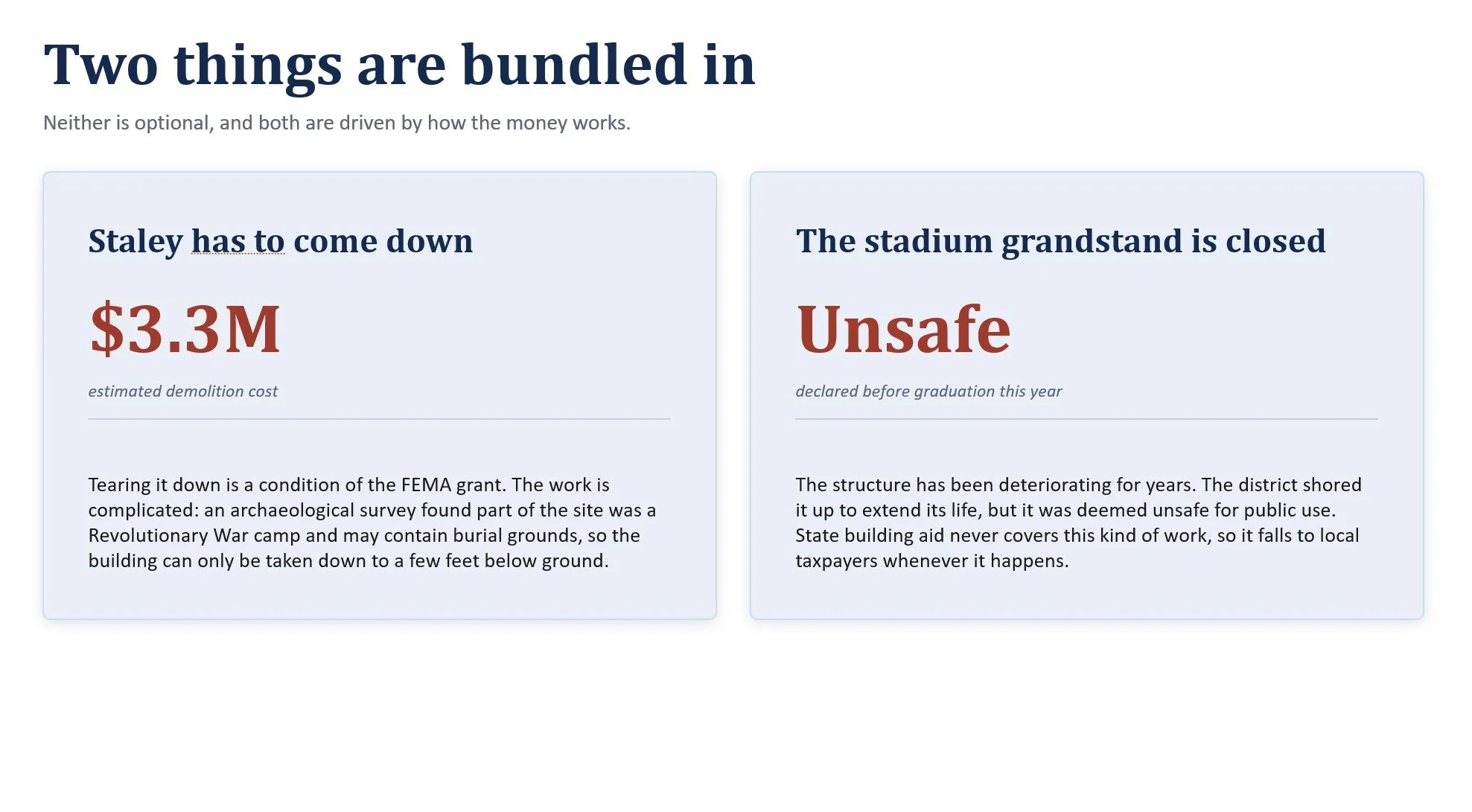
It still captures the FEMA money, still gets Clough ready for sixth grade, and still removes a structure that has been declared unsafe.
It asks the least of taxpayers at a moment when Rome voters just rejected a school budget in May before approving a trimmed version in June.
The Case Against
The stadium is left without permanent seating for an unknown stretch of time. Graduation and other events stay displaced.
The grandstand will still have to be rebuilt eventually, at future prices, and it will always be a local cost. Deferring it doesn't avoid it, it just delays and likely increases it.
Like Option 2, it doesn't add classroom capacity or move fifth grade.
It's the smallest response to a space problem the district has been describing as urgent for four years.
Your Questions, Answered
-
The district says no. Assistant Superintendent for Business Dr. Georgia Gonzalez said her goal is to find enough additional leftover money in the audit to close that gap and make the project zero tax impact.
-
Dr. Georgia Gonzalez said the district has $3.3 million sitting in its capital reserve, plus roughly $3 million in leftover funds from the 2025-26 school year that she plans to ask the board to move into that reserve once auditors finish, likely in September or October. That's about $6.3 million of the $8.0 million required coming from reserves.
-
Clough is already full. It houses the pre-K program, the special education and technology departments, and the district boardroom. All of that has to go somewhere during construction. This is why the district negotiated a five-year lease on the former Rome Catholic School on Cypress Street.
-
Every dollar has to be spent by October 2029. That sounds far off, but a public vote, design work, state review, bidding and construction all have to fit inside it. That deadline is why the board picked an option now.
-
In 2021, Rome lost Staley school to flooding. Since then, the elementary schools have been short on space. Two years ago, the board demanded a long-term fix. So the plan is to turn Clough into a building for older elementary grades.
The arguments above are the ones being made by district officials, their advisers, and board members at public meetings, along with the questions a voter would reasonably raise. They are not this site's endorsement of any option. As the board narrows its choice and organized support or opposition emerges, this page will be updated.